Minimized Accident Risk via Route Optimization
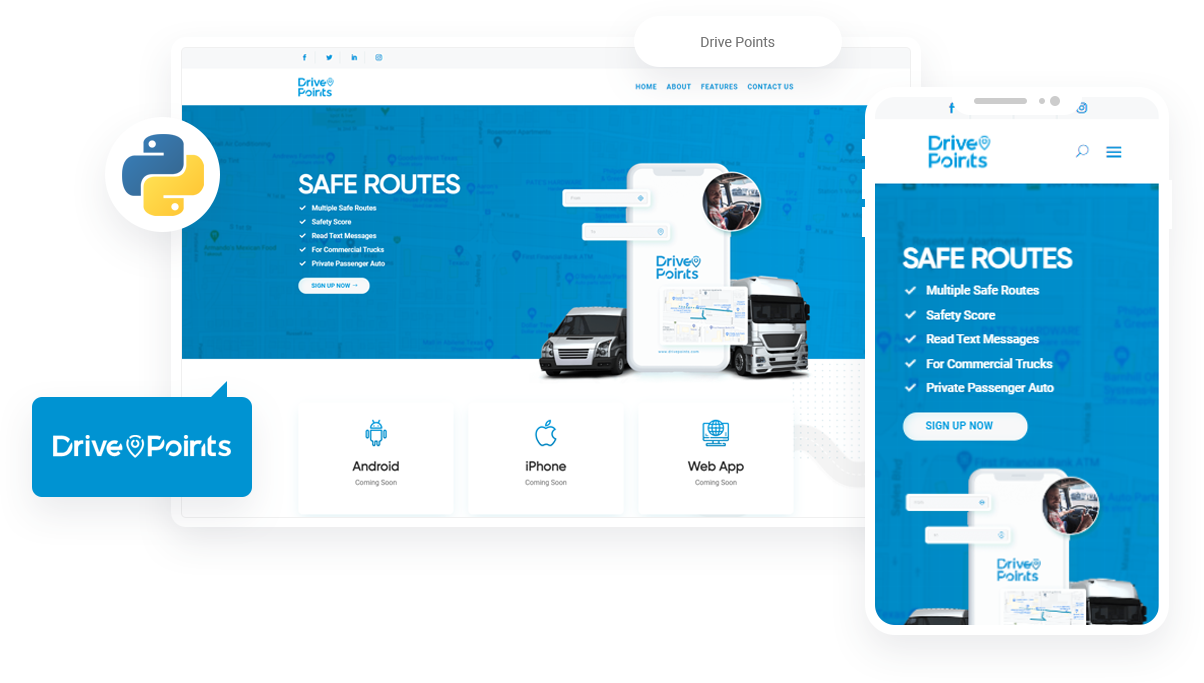
Bridger Insurance required a system that actively suggests the safest routes to drivers, not just the fastest. To meet this need, the challenge was integrating the proprietary Tnedicca algorithm to analyze dynamic risk factors and deliver real-time, accident-minimizing route guidance.
Universal Cross-Platform Driver Experience
The platform needed to deploy critical safety features to all insured vehicles. Therefore, it required dedicated native iOS and Android applications that offer high performance, reliable connectivity, and a consistent, intuitive user interface for all drivers.
Real-Time Fleet and Parcel Tracking
The client demanded reliable, sub-minute updates on vehicle location and parcel status. As such, the system required robust GPS tracking integration and a high-performance Python backend to process, store in MySQL, and display this crucial data instantly to fleet managers.
Seamless Dual-Map Integration
To ensure geographic accuracy and reliability across various regions. The platform had to support and integrate data simultaneously from Google Maps and HERE Maps. The challenge was harmonizing the map APIs to feed the most precise data to the safe route algorithm.
High Scalability and Reliability
The solution needed to be a secure & capable of monitoring thousands of vehicles concurrently. In addition, the entire architecture, hosted on Google Cloud Platform GCP, needed to demonstrate elastic scalability to manage exponential fleet growth.
Intuitive Fleet Manager Dashboard
Fleet managers required a central, web-based control panel (built in React.js) to visualize all fleet activity, performance metrics, and safety alerts. The requirement was for a zero-learning-curve interface that transforms complex data into actionable insights instantly.
Data-Driven Risk Profiling
Beyond tracking, the client needed the system to capture and store detailed driver behavior and route data in the MySQL database. This data was essential for Bridger Insurance to generate accurate risk profiles and adjust insurance premiums accordingly.
Future-Proof Technology Stack
The platform had to be built using modern, maintainable technologies (Python/React) to ensure long-term viability and ease of feature expansion, particularly for integrating future AI and machine learning capabilities related to fleet safety.